Entradas

Imagen
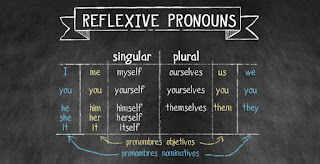
Reflexives pronouns Reflective pronouns are used to emphasize the meaning of the phrase (to enhance the subject who performs the action for "if same"). los pronombres reflexivos son los siguientes: oneself     se, a sí mismo, uno mismo (impersonal) myself     me, a mí mismo, yo mismo yourself     te, tú mismo, a ti mismo, a usted mismo himself     se, a sí mismo, a él mismo herself     se, a sí misma, a ella misma itself         se, a sí mismo, a ello mismo ourselves     nos, a nosotros mismos yourselves     os, a vosotros mismos, a ustedes mismos themselves     se, a sí mismos, a ellos mismos Examples:   wrote this book myself   /   Escribí yo mismo este libro The chairman himself opened the meeting   /   El presidente en persona abrió la reunión - Conjuntamente co...
Imagen
                                                                Modal Verbs Here's a list of the modal verbs in English: can could may might will would must shall should ought to Modals are different from normal verbs: 1: They don't use an 's' for the third person singular. 2: They make questions by inversion ('she can go' becomes 'can she go?'). 3: They are followed directly by the infinitive of another verb (without 'to'). Probability: First, they can be used when we want to say how sure we are that something happened / is happening / will happen. We often call these 'modals of deduction' or 'speculation' or 'certainty' or 'probability'. Ability   For example: She  can speak  six languages. My grandfather  could play  golf very well. I  can't drive. Permission For ex...
Imagen
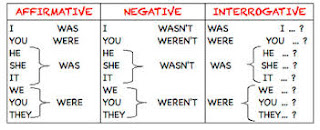
Pasado progresivo Se usa para hablar de una acción que está ocurriendo en algún momento en el pasado, se forma con el verbo  to   be      Ejemplos: I was eating a sandwich. Estaba comiendo un sándwich. The kids were playing. Los niños estaban jugando Past progressive   It is used to talk about an action that is occurring at some time in the past, it is formed with the verb to be Examples:   I was eating a sandwich. I was eating a sandwich.   The kids were playing. The kids were playing
Imagen
Pasado simple Usamos el pasado simple para acciones completas en el pasado , el período de tiempo de estas acciones no es importante como en el español, en el pasado simple hay verbos regulares y  verbos irregulares. Para formar el pasado simple con verbos regulares, usamos el infinitivo y añadimos la terminación “-ed ”. La forma es la misma para todas las personas.   Ø    Para verbos que terminan en una  “e” ,  sólo añadimos  “ -d ”. Ø    Si el verbo termina en una vocal corta y una consonante (excepto  “y” o “w”), doblamos la consonante final. Ø    Si el verbo termina en una vocal corta y una consonante (excepto  “y” o “w”) Simple past Usamos el pasado simple para acciones completas en el pasado, el período de tiempo de estas acciones no es importante en el español, en el pasado simple hay verbos regulares y verbos irregulares. Para formar el pasado simple con verbos regul...